How this site works
Sizing charts maintained by Noureddine M.
FurPick exists because harness sizes do not mean the same thing at different brands, and nobody translates between them. A dog with a 76cm chest is a Julius-K9 “1” and a Ruffwear “M”. Every brand publishes its own chart and stops there. This site reads all of them at once.
Where the numbers come from
Every size range here — 70 sizes across 12 charts from 11 brands — is transcribed from the manufacturer’s own published chart. Each one is stored with the page it came from and the date it was read, and both are printed on the brand page so you can check them yourself. Where a brand publishes only inches, the conversion is recorded in the source note.
Nothing is estimated. Nothing is averaged between brands. Nothing is copied from another comparison site.
- Julius-K9 — IDC Powerharness · source · read 2026-08-19
- Ruffwear — Harness (girth sizing) · source · read 2026-10-04
- PetSafe — Easy Walk Harness · source · read 2026-08-19
- Kurgo — Tru-Fit Smart Harness · source · read 2026-08-19
- Blue-9 — Balance Harness · source · read 2026-08-19
- Rabbitgoo — ControlPro No-Pull Harness · source · read 2026-08-28
- Puppia — RiteFit Harness · source · read 2026-08-28
- PetSafe 3 in 1 — Easy Walk 3 in 1 Harness · source · read 2026-10-04
- Dog Friendly Co — No-Pull Dog Harness · source · read 2026-10-04
- PawSafe — Steady+Style No Pull Harness · source · read 2026-10-04
- Wonder Walker — No-Pull Harness · source · read 2026-10-04
- Top Paw — Mesh Comfort Dog Harness · source · read 2026-10-04
How a chart is read
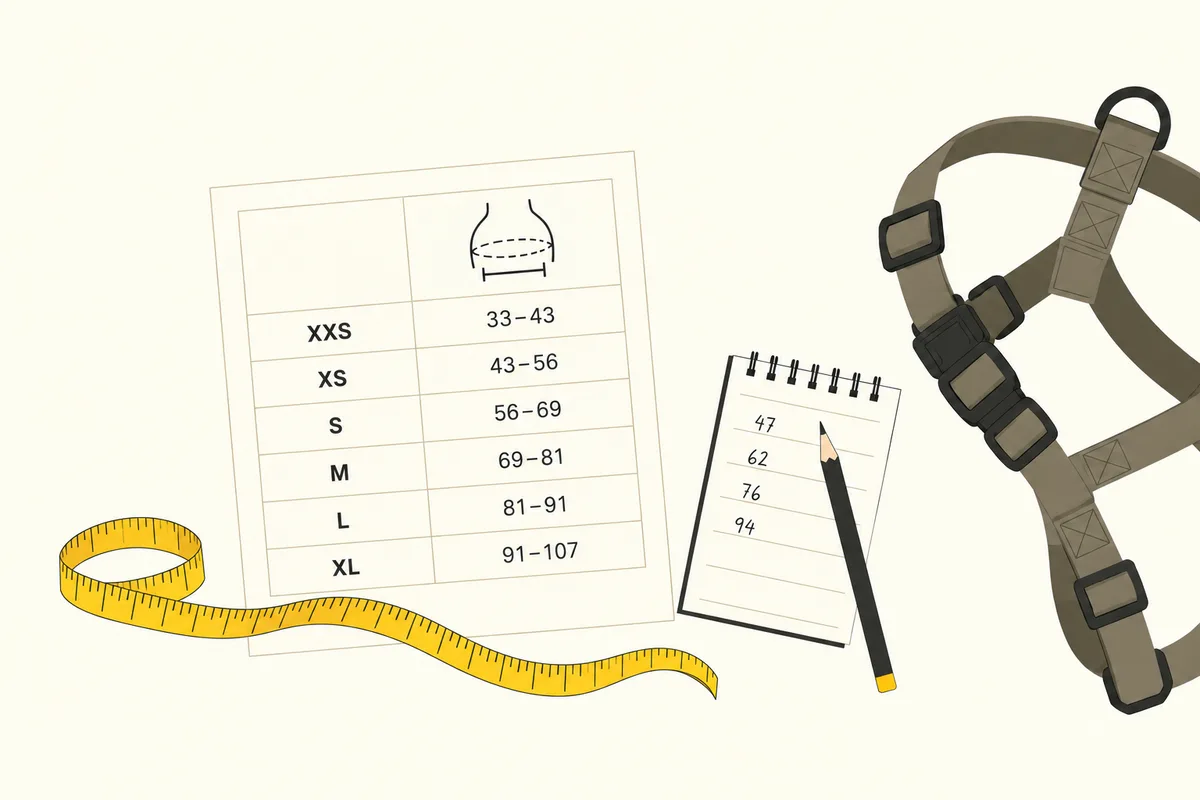
- Start from the maker’s own chart. The brand’s size guide, or the chart on its own product page — never a retailer listing, a review, or another comparison site. If a brand only publishes its chart as an image, the figures are read off that image.
- Copy every size exactly as printed. The label as the brand spells it ("Petite/Small", "M/L", "Baby 1"), the chest range, and the weight guide where there is one. Nothing is rounded to make a table look tidier.
- Convert only when forced, and say so. A chart printed only in inches is converted at 2.54 cm to the inch (pounds at 2.2046 to the kilogram), rounded to a tenth, and the brand page notes it.
- Record where and when. The source address and the date the chart was read are stored with it and printed on its brand page, so any figure can be checked against the original.
- Let the code check the copy. Automated tests run before every deploy: every range must be internally sane — sizes in order, no range ending before it starts — and every published size must be reachable by some real measurement.
- Replace it when the brand changes it. Brands revise their charts. When one does, the new figures and the new date replace the old ones. If a figure here disagrees with the brand’s current chart, the brand is right.
What we refuse to guess
Ruffwear, Blue-9, Rabbitgoo, Puppia, Dog Friendly Co and Top Paw size by chest girth alone and publish no weight guidance. So on the 60 breed pages, those brands are left blank with an instruction to measure, rather than filled in with a number.
This is the main thing that separates these pages from the ones currently ranking for the same searches. They print a confident size for every brand, including the ones whose charts cannot support one. That number had to come from somewhere, and it was not the manufacturer. A blank that tells you to reach for a tape is worth more than a number someone made up.
Why a breed is never one size
Breed pages use the adult weight range in the recorded breed standard to suggest a shortlist where a maker provides weight guidance. That shortlist cannot establish chest fit. Measure your dog’s girth and check the maker’s chart before choosing a size; girth-only charts require that measurement.
How the site makes money
FurPick earns through affiliate links: a retailer link (“Shop…”, “See … on …”) can pay a commission when you buy, at no cost to you, and every such link is marked as sponsored. That creates an obvious conflict, so it is worth stating the rule plainly: the sizing logic does not know and does not care which brands pay. Sizes are computed from the charts, and a brand that pays nothing is ranked and reported exactly like a brand that does. If that ever stops being true, this paragraph comes down.
How the writing is produced
FurPick uses AI-assisted writing. The current workflow prepares up to one draft a day and runs automated checks for word count, section structure, unsupported chart ranges and prohibited claims. Publication is a separate manual action; generating a draft does not publish it.
FurPick has not tested products. Its guides explain manufacturers’ published charts and how to take the measurements those charts require. A chart-based size suggestion is not a hands-on product review or a guarantee of fit.
The sizing data is held to a different rule from the writing: it is never generated. Every range is a figure the manufacturer printed, stored with its source and the date it was read, and no model writes or changes it. The article checks refuse any size label paired with a range the brand does not publish.
Who runs it
FurPick’s sizing charts are maintained by Noureddine M.. Articles are attributed to FurPick as an organisation, reflecting the AI-assisted writing process. That byline does not claim personal authorship or a personal review of every article. If a figure here disagrees with a brand’s own current chart, the brand is right and we want to know — brands revise their sizing, and a stale number here is a harness that does not fit.
What a harness has to do
A harness that does not fit is a harness a dog can back out of, usually at the worst possible moment. That is the whole reason this site is fussy about a centimetre. If your measurement lands right on the edge of a range, take the size that leaves adjustment in hand rather than the one that only just closes.