Do no-pull harnesses work? Steering, not training
FurPick · 25 August 2026 · 5 min read
A front-clip harness steers a pulling dog rather than teaching it anything. Here's how the two no-pull designs differ, where front-clips fall short and why chest fit matters most.
"No-pull" is the name of a category, not a promise. No harness takes away a dog's wish to reach the next lamppost before you do. What it can change is what happens when the dog tries. That's worth having, as long as you know which of two very different designs you've bought and the harness fits well enough to work.
The two mechanisms sold under one name
Front-clip: redirection
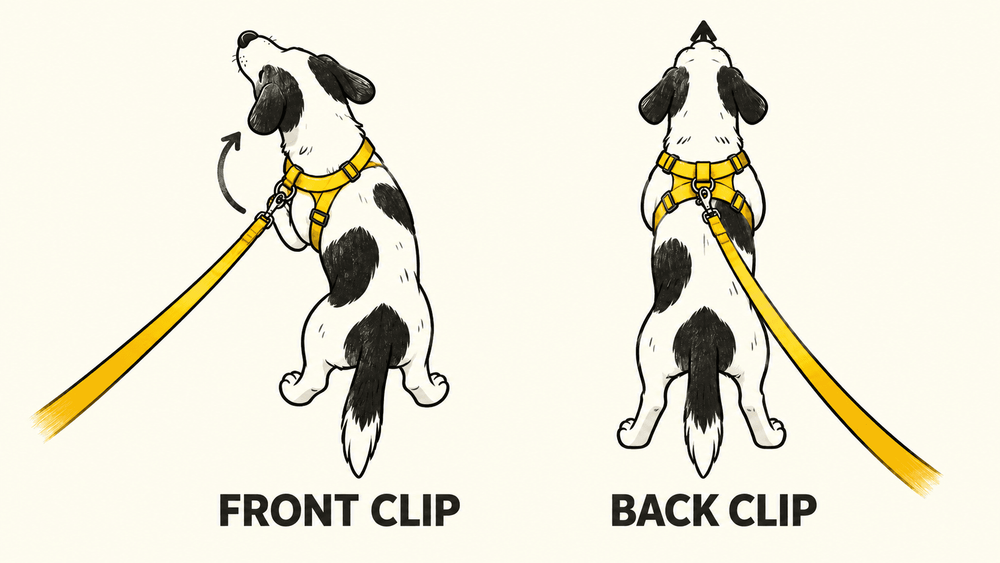
With a front-clip, the lead attaches at the chest. When the dog pulls, the tension comes from the front and swings its shoulders round towards you. Nothing hurts. The dog just finds itself facing the wrong way and stops getting anywhere.
Think of it as steering. You'll notice the difference on the first walk, even with a strong dog, and you'll lose it the day the harness comes off. The dog hasn't learned anything. It has only been stopped.
Tightening designs: discomfort
Other harnesses sold as no-pull tighten when the dog pulls, usually across the chest or under the front legs. The dog backs off because pulling has started to feel unpleasant.
They can seem to work faster, but they're a different thing altogether. A strap that draws in under the front legs can rub, and on a long walk it can get in the way of the shoulder. There's a quieter risk too: a dog that finds walks uncomfortable may start to dislike the walk itself, not just the pulling. If you see rubbing, hair loss or a change in the way your dog moves, take the harness off and ask your vet.
How to tell which one you've got
The packaging rarely spells it out, so look at the harness itself. A ring on the chest means a front clip. If the only ring is on the back, the harness won't redirect at all. Next, look for a strap that runs through a ring or loop so it can shorten under tension. That's the sign of a tightening design. If you're still unsure, buckle the harness on the dog and draw the lead forward gently by hand. If the whole harness turns, it's redirecting. If a strap visibly draws in, it's tightening.
What "works" should mean
A fair test has two parts. Is the walk manageable today? And has the dog stopped practising the pull?
The second part is the one people overlook. Each time a dog pulls and then reaches something interesting, it learns that pulling pays. A front-clip interrupts that: the dog pulls, swings sideways and doesn't get there. Over a few weeks, that alone can take the edge off the pulling. The harness hasn't taught anything. The walk has just stopped teaching the wrong lesson.
What it won't give you is a dog that walks nicely on a flat collar. If that's where you want to end up, use the harness during training, not in place of it. Reward a loose lead, and stand still when it goes tight.
Where front-clips fall down
Start by checking where the straps sit. Some front-clips run a strap straight across the front of the shoulders, where it can limit how far the front legs reach. A Y-shaped chest piece rests on the breastbone and keeps clear of the point of the shoulder. The further your dog walks, the more that matters.
Then there's the lead. Clipped at the chest, it hangs among the front legs, and the dog steps over it whenever it turns or stops to sniff. It's one of the commonest reasons people quietly give up on front-clips. A shorter lead, held on the side your dog walks, helps.
Size matters as well. With a 4kg dog you can hold your ground anyway, so redirection adds little. If you do use one on a small dog, check the hardware isn't heavy for its frame.
Lunging is the hardest case. A dog that hits the end of the lead at speed puts a sudden sideways load through a front-clip. If yours lunges at dogs, people or traffic, a harness won't fix that on its own. A qualified behaviourist is the better next step, and if you're worried about the strain on your dog's body, ask your vet.
The dual-clip compromise
Plenty of harnesses now have one ring at the chest and another on the back, so one harness can do two jobs. Use the front ring on busy pavements and training walks. Switch to the back ring on open ground or a long line, where redirection achieves nothing and a lead clipped at the chest tangles constantly.
It also means the harness is still worth having once the pulling eases, instead of ending up in a drawer.
The thing that decides whether any of it works
It comes down to fit, and fit at the chest in particular.
A loose front-clip rotates around the dog. The chest ring drifts off the centreline, the redirection goes lopsided, and the dog works out that it can lean through one side. Then you're left with the tangling and none of the benefit.
A quick fit check
Put the harness on and look at the chest ring first. It should sit in the middle of the breastbone, not off to one side or down between the legs. Give the lead a gentle sideways tug: the ring should stay more or less central rather than sliding round. You should be able to slide flat fingers under each strap without forcing them, and nothing should press into the armpits. Check again after a few walks, because adjusters can slip.
Why the last harness's size tells you little
Sizes don't carry over from one maker to another. Say your dog's chest girth is 66cm. On Julius-K9's IDC Powerharness chart, as FurPick checked it on 19 August 2026, that measurement falls into two sizes: Mini (49–67cm) and 0 (58–76cm). On Ruffwear's harness girth chart, checked on 4 October 2026, it lands in S (56–69cm), and M starts at 69cm. So the same dog is a Julius-K9 Mini or 0 and a Ruffwear S. None of those labels means anything on the other maker's chart.
Where your dog sits within a range matters as much as the label. At 66cm, the Julius-K9 Mini has only 1cm left before its upper limit. The 0 has 8cm below and 10cm above, and the Ruffwear S has 3cm to spare. When two sizes overlap, choose the one that puts your dog nearer the middle. That leaves room to adjust for a thicker winter coat or a small change in weight. Makers do revise their charts, so check the current figures before you order.
Measure the chest once, following the measuring instructions on the chart you're using. Then compare that number with each maker's chart instead of carrying a size label across.
If a harness keeps riding forward, or your dog can reverse out of it, that's a fit problem too. Why dogs back out of harnesses goes through the checks.
FurPick uses AI-assisted writing and automated checks. Its current workflow prepares up to one draft a day, with publication as a separate manual action. FurPick has not tested products. The sizing data it draws on is transcribed from each manufacturer’s own published chart, with the source and the date it was read. How this site works.
Common questions
Will a front-clip harness stop my dog pulling for good?
No. It turns your dog back towards you when it pulls, which makes walks manageable and stops pulling from paying off. Take it off and most dogs pull just as before. Use it alongside loose-lead training, not instead of it.
How can I tell if a no-pull harness tightens when my dog pulls?
Look for a strap that runs through a ring or loop so it can shorten under tension, often across the chest or under the front legs. With the harness fitted, draw the lead forward gently by hand. If a strap draws in rather than the whole harness turning, it's a tightening design. If you notice rubbing or a change in how your dog moves, ask your vet.
My dog's chest measurement fits two sizes. Which should I choose?
Choose the size where your dog's measurement sits nearer the middle of the range, so you can adjust it either way. On Julius-K9's IDC Powerharness chart, as FurPick checked it on 19 August 2026, a 66cm chest fits both Mini (49–67cm) and 0 (58–76cm), and the 0 leaves room in both directions. Check the maker's current chart before you order, and don't carry a size label from one brand to another.
Why does my front-clip harness keep twisting to one side?
It's usually too loose. Once the chest ring drifts off the centre of the breastbone, the redirection goes lopsided and the dog learns to lean through one side. Tighten the straps until the ring stays central when you tug the lead sideways. If it still won't sit right, measure the chest again and check the size.